Saturday, July 2, 2011

AVOGADRO'S LAW

Avogadro's law (sometimes referred to as Avogadro's hypothesis or Avogadro's principle) is a gas law named after Amedeo Avogadro who, in 1811, hypothesized that two given samples of an ideal gas, at the same temperature, pressure and volume, contain the same number of molecules. Thus, the number of molecules or atoms in a specific volume of gas is independent of their size or the molar mass of the gas.

As an example, equal volumes of molecular hydrogen and nitrogen contain the same number of molecules when they are at the same temperature and pressure, and observe ideal gas behavior. In practice, real gases show small deviations from the ideal behavior and the law holds only approximately, but is still a useful approximation for scientists.

Avogadro's law is stated mathematically as:
\frac{V}{n} = k
Where:
V is the volume of the gas.
n is the amount of substance of the gas.
k is a proportionality constant.
The most significant consequence of Avogadro's law is that the ideal gas constant has the same value for all gases. This means that:
\frac{p_1\cdot V_1}{T_1\cdot n_1}=\frac{p_2\cdot V_2}{T_2 \cdot n_2} = constant
Where:
p is the pressure of the gas
T is the temperature in kelvin of the gas

CHARLE'S LAW

Charles's law (also known as the law of volumes) is an experimental gas law which describes how gases tend to expand when heated. It was first published by French natural philosopher Joseph Louis Gay-Lussac in 1802, although he credited the discovery to unpublished work from the 1780s by Jacques Charles. The law was independently discovered by British natural philosopher John Dalton by 1801, although Dalton's description was less thorough than Gay-Lussac's. The basic principles had already been described a century earlier by Guillaume Amontons.Gay-Lussac was the first to demonstrate that the law applied generally to all gases, and also to the vapours of volatile liquids if the temperature was more than a few degrees above the boiling point.
At constant pressure, the volume of a given mass of an ideal gas increases or decreases by the same factor as its temperature on the absolute temperature scale (i.e. the gas expands as the temperature increases).which can be written as:


V \propto T\,
where V is the volume of the gas; and T is the absolute temperature. The law can also be usefully expressed as follows:
\frac{V_1}{T_1} = \frac{V_2}{T_2} \qquad \mathrm{or} \qquad \frac {V_2}{V_1} = \frac{T_2}{T_1} \qquad \mathrm{or} \qquad V_1 T_2 = V_2 T_1.
The equation shows that, as absolute temperature increases, the volume of the gas also increases in proportion.

In modern physics, Charles's Law is seen as a special case of the ideal gas equation, in which the pressure and number of molecules are held constant. The ideal gas equation is usually derived from the kinetic theory of gases, which presumes that molecules occupy negligible volume, do not attract each other and undergo elastic collisions (no loss of kinetic energy); an imaginary gas with exactly these properties is termed an ideal gas. The behavior of a real gas is close to that of an ideal gas under most circumstances, which makes the ideal gas law useful. Gases made up of polar molecules (for example, water) deviate more from this ideal, so Charles's Law is less accurate in describing the behavior of these gases.
This law of volumes implies theoretically that as a temperature reaches absolute zero the gas will shrink down to zero volume. This is not physically correct, since in fact all gases turn into liquids at a low enough temperature, and Charles's law is not applicable at low temperatures for this reason.
The fact that the gas will occupy a non-zero volume - even as the temperature approaches absolute zero - arises fundamentally from the uncertainty principle of quantum theory. However, as the temperature is reduced, gases turn into liquids long before the limits of the uncertainty principle come into play due to the attractive forces between molecules which are neglected by Charles's Law.

BOYLE'S LAW

Boyle's law (sometimes referred to as the Boyle-Mariotte law) is one of many gas laws and a special case of the ideal gas law. Boyle's law describes the inversely proportional relationship between the absolute pressure and volume of a gas, if the temperature is kept constant within a closed system. The law was named after chemist and physicist Robert Boyle, who published the original law in 1662. The law itself can be stated as follows:

For a fixed amount of an ideal gas kept at a fixed temperature, P [pressure] and V [volume] are inversely proportional (while one doubles, the other halves).This relationship between pressure and volume was first noted by two amateur scientists, Richard Towneley and Henry Power. Boyle confirmed their discovery through experiments and published the results. According to Robert Gunther and other authorities, it was Boyle's assistant, Robert Hooke, who built the experimental apparatus. Boyle's law is based on experiments with air, which he considered to be a fluid of particles at rest in between small invisible springs. At that time, air was still seen as one of the four elements, but Boyle disagreed. Boyle's interest was probably to understand air as an essential element of life; he published e.g. the growth of plants without air. The French physicist Edme Mariotte (1620–1684) discovered the same law independently of Boyle in 1676, but Boyle had already published it in 1662. Thus this law may, improperly, be referred to as Mariotte's or the Boyle-Mariotte law. Later, in 1687 in the PhilosophiƦ Naturalis Principia Mathematica, Newton showed mathematically that if an elastic fluid consisting of particles at rest, between which are repulsive forces inversely proportional to their distance, the density would be directly proportional to the pressure, but this mathematical treatise is not the physical explanation for the observed relationship. Instead of a static theory a kinetic theory is needed, which was provided two centuries later by Maxwell and Boltzmann.

Boyle’s law states that at constant temperature for a fixed mass, the absolute pressure and the volume of a gas are inversely proportional. The law can also be stated in a slightly different manner, that the product of absolute pressure and volume is always constant.
Most gases behave like ideal gases at moderate pressures and temperatures. The technology of the 17th century could not produce high pressures or low temperatures. Hence, the law was not likely to have deviations at the time of publication. As improvements in technology permitted higher pressures and lower temperatures, deviations from the ideal gas behavior would become noticeable, and the relationship between pressure and volume can only be accurately described employing real gas theory. The deviation is expressed as the compressibility factor.
Robert Boyle (and Edme Mariotte) derived the law solely on experimental grounds. The law can also be derived theoretically based on the presumed existence of atoms and molecules and assumptions about motion and perfectly elastic collisions (see kinetic theory of gases). These assumptions were met with enormous resistance in the positivist scientific community at the time however, as they were seen as purely theoretical constructs for which there was not the slightest observational evidence.
Daniel Bernoulli in 1738 derived Boyle's law using Newton's laws of motion with application on a molecular level. It remained ignored until around 1845, when John Waterston published a paper building the main precepts of kinetic theory; this was rejected by the Royal Society of England. Later works of James Prescott Joule, Rudolf Clausius and in particular Ludwig Boltzmann firmly established the kinetic theory of gases and brought attention to both the theories of Bernoulli and Waterston.
The debate between proponents of Energetics and Atomism led Boltzmann to write a book in 1898, which endured criticism up to his suicide in 1906.Albert Einstein in 1905 showed how kinetic theory applies to the Brownian motion of a fluid-suspended particle, which was confirmed in 1908 by Jean Perrin.

Friday, July 1, 2011

MOLE CONCEPT


The mole is a unit of measurement used in chemistry to express amounts of a chemical substance, equal to about 6.02214×10²³ molecules of that substance. It is one of the base units in the International System of Units, and has the unit symbol mol.
The mole is widely used in chemistry, instead of units of mass or volume, as a convenient way to express the amounts of reagents and products of chemical reactions. For example, the chemical equation 2 H2 + O2 → 2 H2O implies that 2 mol of dihydrogen and 1 mol of dioxygen react to form 2 mol of water. The mole may also be used to express the number of atoms, ions, or other elementary entities in some sample. The concentration of a solution is commonly expressed by its molarity, the number of moles of the dissolved subtance per liter of solution.
The number of molecules in a mole (known as Avogadro's number) is defined so that the mass of one mole of a substance, expressed in grams, is exactly equal to the substance's mean molecular weight. For example, the mean molecular weight of natural water is about 18.015, so one mole of water is about 18.015 grams. This property considerably simplifies many chemical and physical computations.
The name gram-molecule was formerly used for essentially the same concept.The name gram-atom (abbreviated gat.) has been used for related but distinct concept, namely a quantity of a substance that contains Avogadro's number of atoms, whether isolated or combined in molecules. Thus, for example, 1 mole of MgB2 is 1 gram-molecule of MgB2 but 3 gram-atoms of MgB2.


As of 2011, the mole is defined by IUPAC to be an amount of a substance that contains as many elementary entities (e.g., atoms, molecules, ions, electrons) as there are atoms in 12 grams of pure carbon-12 (12C), the isotope of carbon with atomic weight 12. Thus, by definition, one mole of pure 12C has a mass of exactly 12 g. It also follows from the definition that X moles of any substance will contain the same number of molecules as X moles of any other substance.
The mass per mole of a substance is called its molar mass. Since the standard unit for expressing the mass of molecules or atoms (the dalton or atomic mass unit) is defined as 1/12 of the mass of a 12C atom, it follows that the molar mass of a substance, measured in grams per mole, is exactly equal to its mean molecular or atomic mass, measured in daltons; which is to say, to the substance's mean molecular or atomic weight.
The number of elementary entities in a sample of a substance is technically called its (chemical) amount. Therefore, the mole is a convenient unit for that physical quantity. One can determine the chemical amount of a known substance, in moles, by dividing the sample's mass by the substance's molar mass. Other methods include the use of the molar volume or the measurement of electric charge.
It should be noted that the mass of one mole of a substance depends not only on its molecular formula, but also on the proportion of the isotopes of each element present in it. For example, one mole of calcium-40 is 39.96259098 ± 0.00000022 grams, whereas one mole of calcium-42 is 41.95861801 ± 0.00000027 grams, and one mole of calcium with the normal isotopic mix is 40.078 ± 0.004 grams.
Since the definition of the gram is not (as of 2011) mathematically tied to that of the dalton, the number NA of molecules in a mole (Avogadro's number) must be determined experimentally. The value adopted by CODATA in 2006 is NA = 6.02214179×10²³ ± 0.00000030×10²³.In 2011 the measurement was refined to 6.02214078×10²³ ± 0.00000018×10²³.

Friday, January 21, 2011

Carbon cycle


The carbon cycle is the biogeochemical cycle by which carbon is exchanged among thebiosphere, pedosphere, geosphere, hydrosphere, and atmosphere of the Earth. It is one of the most important cycles of the earth and allows for carbon to be recycled and reused throughout the biosphere and all of its organisms.[citation needed]
The carbon cycle was initially discovered byJoseph Priestley and Antoine Lavoisier, and popularized by Humphry Davy.[1] It is now usually thought of as including the following major reservoirs of carbon interconnected by pathways of exchange:
  • The atmosphere
  • The terrestrial biosphere, which is usually defined to include fresh water systems and non-living organic material, such as soil carbon.
  • The oceans, including dissolved inorganic carbon and living and non-living marine biota,
  • The sediments including fossil fuels.
  • The Earth's interior, carbon from the Earth'smantle and crust is released to the atmosphere and hydrosphere by volcanoes and geothermal systems.
The annual movements of carbon, the carbon exchanges between reservoirs, occur because of various chemical, physical, geological, and biological processes. The ocean contains the largest active pool of carbon near the surface of the Earth, but the deep ocean part of this pool does not rapidly exchange with the atmosphere in the absence of an external influence, such as a black smoker or an uncontrolled deep-water oil well leak.
The global carbon budget is the balance of the exchanges (incomes and losses) of carbon between the carbon reservoirs or between one specific loop (e.g., atmosphere ↔ biosphere) of the carbon cycle. An examination of the carbon budget of a pool or reservoir can provide information about whether the pool or reservoir is functioning as a source or sink for carbon dioxide.

Tuesday, January 18, 2011

Fuel Cell

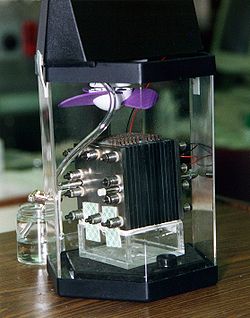
A fuel cell is an electrochemical cell that converts a source fuel into an electric current. It generates electricity inside a cell through reactions between a fuel and an oxidant, triggered in the presence of an electrolyte. The reactants flow into the cell, and the reaction products flow out of it, while the electrolyte remains within it. Fuel cells can operate continuously as long as the necessary reactant and oxidant flows are maintained.
Fuel cells are different from conventional electrochemical cell batteries in that they consume reactant from an external source, which must be replenished – a thermodynamically open system. By contrast, batteries store electrical energy chemically and hence represent a thermodynamically closed system.
Many combinations of fuels and oxidants are possible. A hydrogen fuel cell uses hydrogen as its fuel and oxygen (usually from air) as its oxidant. Other fuels include hydrocarbons and alcohols. Other oxidants include chlorine and chlorine dioxide.


 n the archetypal hydrogen–oxygen proton exchange membrane fuel cell (PEMFC) design, a proton-conducting polymer membrane, (the electrolyte), separates the anode and cathode sides. This was called a "solid polymer electrolyte fuel cell" (SPEFC) in the early 1970s, before the proton exchange mechanism was well-understood. (Notice that "polymer electrolyte membrane" and "proton exchange mechanism" result in the same acronym.)
On the anode side, hydrogen diffuses to the anode catalyst where it later dissociates into protons and electrons. These protons often react with oxidants causing them to become what is commonly referred to as multi-facilitated proton membranes. The protons are conducted through the membrane to the cathode, but the electrons are forced to travel in an external circuit (supplying power) because the membrane is electrically insulating. On the cathode catalyst, oxygen molecules react with the electrons (which have traveled through the external circuit) and protons to form water — in this example, the only waste product, either liquid or vapor.
In addition to this pure hydrogen type, there are hydrocarbon fuels for fuel cells, including diesel, methanol (see: direct-methanol fuel cells and indirect methanol fuel cells) and chemical hydrides. The waste products with these types of fuel are carbon dioxide and water.
Construction of a high temperature PEMFC: Bipolar plate as electrode with in-milled gas channel structure, fabricated from conductive plastics (enhanced with carbon nanotubes for more conductivity); Porous carbon papers; reactive layer, usually on the polymer membrane applied; polymer membrane.

Condensation of water produced by a PEMFC on the air channel wall. The gold wire around the cell ensures the collection of electric current.[4]
The materials used in fuel cells differ by type. In a typical membrane electrode assembly (MEA), the electrode–bipolar plates are usually made of metal, nickel or carbon nanotubes, and are coated with a catalyst (like platinum, nano iron powders or palladium) for higher efficiency. Carbon paper separates them from the electrolyte. The electrolyte could be ceramic or a membrane.


Nitrogen Cycle

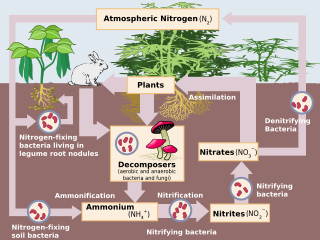
The nitrogen cycle is the process by which nitrogen is converted between its various chemical forms. This transformation can be carried out via both biological and non-biological processes. Important processes in the nitrogen cycle include fixation, mineralization, nitrification, and denitrification. The majority of Earth's atmosphere (approximately 78%) is nitrogen,making it the largest pool of nitrogen. However, atmospheric nitrogen is unavailable for biological use, leading to a scarcity of usable nitrogen in many types of ecosystems. The nitrogen cycle is of particular interest to ecologists because nitrogen availability can affect the rate of key ecosystem processes, including primary production and decomposition. Human activities such as fossil fuel combustion, use of artificial nitrogen fertilizers, and release of nitrogen in wastewater have dramatically altered the global nitrogen cycle.


Nitrogen is present in the environment in a wide variety of chemical forms including organic nitrogen, ammonium (NH4+), nitrate (NO3-), and nitrogen gas (N2). The processes of the nitrogen cycle transform nitrogen from one chemical form to another. Many of the processes are carried out by microbes either to produce energy or to accumulate nitrogen in the form needed for growth. The diagram above shows how these processes fit together to form the nitrogen cycle.